Tuesday, June 19, 2012

OH !!!!
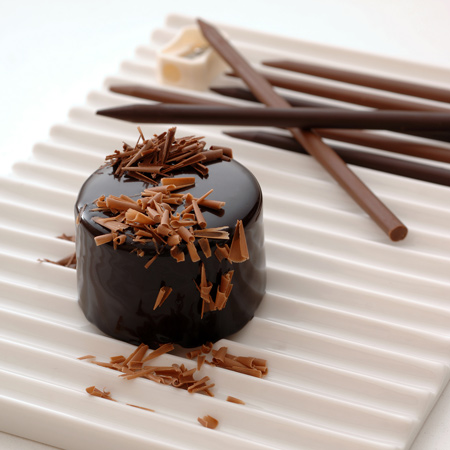
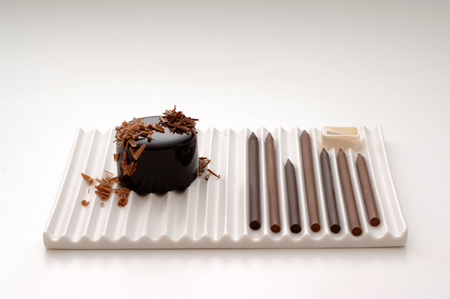
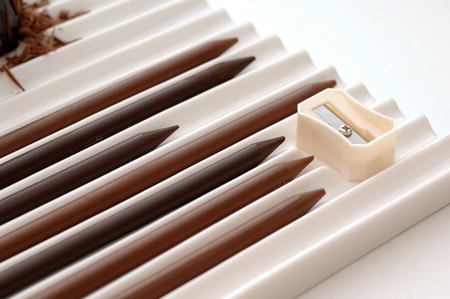
Japanese designers Nendo have created chocolate pencils for Tokyo patissier Tsujiguchi Hironobu. The pencils come with a sharpener so chocolate shavings can be grated on top of pastries and desserts.
Chocolate-pencils is a collaboration with patissier Tsujiguchi Hironobu, the mastermind behind popular dessert shops like Mont St. Claire and Le Chocolat de H.
Tsujiguchi created a new dessert based on his impression of Nendo
after conversations with us, and we designed new tableware for them.
We wanted our plates to show off the beauty of meals and desserts like a
painting on a canvas. Based on this idea, our “chocolate pencils” come
in a number of cocoa blends that vary in intensity, and chocophiles can
use the special “pencil sharpener” that comes with our plate to grate
chocolate onto their dessert.
Pencil filings are usually the unwanted remains of sharpening a pencil but in this case they’re the star!
Tuesday, June 12, 2012
Chocolate
- Hi! My name is Premkamon Burakitphachai. I really love chocolate.


Chocolate is a raw or processed food produced from the seed of the tropical Theobroma cacao tree. Cacao has been cultivated for at least three millennia in Mexico, Central and South America. Its earliest documented use is around 1100 BC. The majority of the Mesoamerican people made chocolate beverages, including the Aztecs, who made it into a beverage known as xocolātl, a Nahuatl word meaning "bitter water". The seeds of the cacao tree have an intense bitter taste, and must be fermented to develop the flavor.
After fermentation, the beans are dried, then cleaned, and then
roasted, and the shell is removed to produce cacao nibs. The nibs are
then ground to cocoa mass,
pure chocolate in rough form. Because this cocoa mass usually is
liquefied then molded with or without other ingredients, it is called chocolate liquor. The liquor also may be processed into two components: cocoa solids and cocoa butter. Unsweetened baking chocolate
(bitter chocolate) contains primarily cocoa solids and cocoa butter in
varying proportions. Much of the chocolate consumed today is in the form
of sweet chocolate, combining cocoa solids, cocoa butter or other fat, and sugar. Milk chocolate is sweet chocolate that additionally contains milk powder or condensed milk. White chocolate contains cocoa butter, sugar, and milk but no cocoa solids.
Cocoa solids contain alkaloids such as theobromine and phenethylamine, which have physiological effects on the body. It has been linked to serotonin levels in the brain. Some research found that chocolate, eaten in moderation, can lower blood pressure. The presence of theobromine renders chocolate toxic to some animals, especially dogs and cats.
Chocolate has become one of the most popular food types and flavors
in the world. Gifts of chocolate molded into different shapes have
become traditional on certain holidays: chocolate bunnies and eggs are popular on Easter, chocolate coins on Hanukkah, Santa Claus and other holiday symbols on Christmas, and chocolate hearts or chocolate in heart-shaped boxes on Valentine's Day. Chocolate is also used in cold and hot beverages, to produce chocolate milk and hot chocolate.
Cocoa mass was used originally in Mesoamerica both as a beverage and as an ingredient in foods. Chocolate played a special role in both Maya and Aztec
royal and religious events. Priests presented cacao seeds as offerings
to the gods and served chocolate drinks during sacred ceremonies. All of
the areas that were conquered by the Aztecs that grew cacao beans were
ordered to pay them as a tax, or as the Aztecs called it, a "tribute".
The Europeans sweetened
and fattened it by adding refined sugar and milk, two ingredients
unknown to the Mexicans. By contrast, the Europeans never infused it
into their general diet, but have compartmentalized its use to sweets
and desserts. In the 19th century, Briton John Cadbury
developed an emulsification process to make solid chocolate creating
the modern chocolate bar. Although cocoa is originally from the
Americas, today Western Africa produces almost two-thirds of the world's
cocoa, with Côte d'Ivoire growing almost half of it.
Subscribe to:
Posts (Atom)